
Most healthcare organizations recognize the necessity of having a reliable plan for data destruction, document destruction, and electronic recycling, yet executing these steps in a straightforward and cost-effective manner can often be challenging. For independent practices and healthcare networks, choosing the right partners who understand regulatory requirements, possess the right certifications, and can seamlessly integrate all components of a security program is a critical operational decision.
When evaluating criteria for an information security partner, I highly recommend prioritizing certified vendors who provide:
(1) HIPAA-compliant destruction for both paper and digital data,
(2) Maintain a documented chain-of-custody, and
(3) Employ environmentally responsible e-waste processing.
Ultimately, your practice's goal is to establish an audit-ready program that renders Protected Health Information (PHI) irretrievable, while simultaneously validating that you have met both federal and state environmental standards.
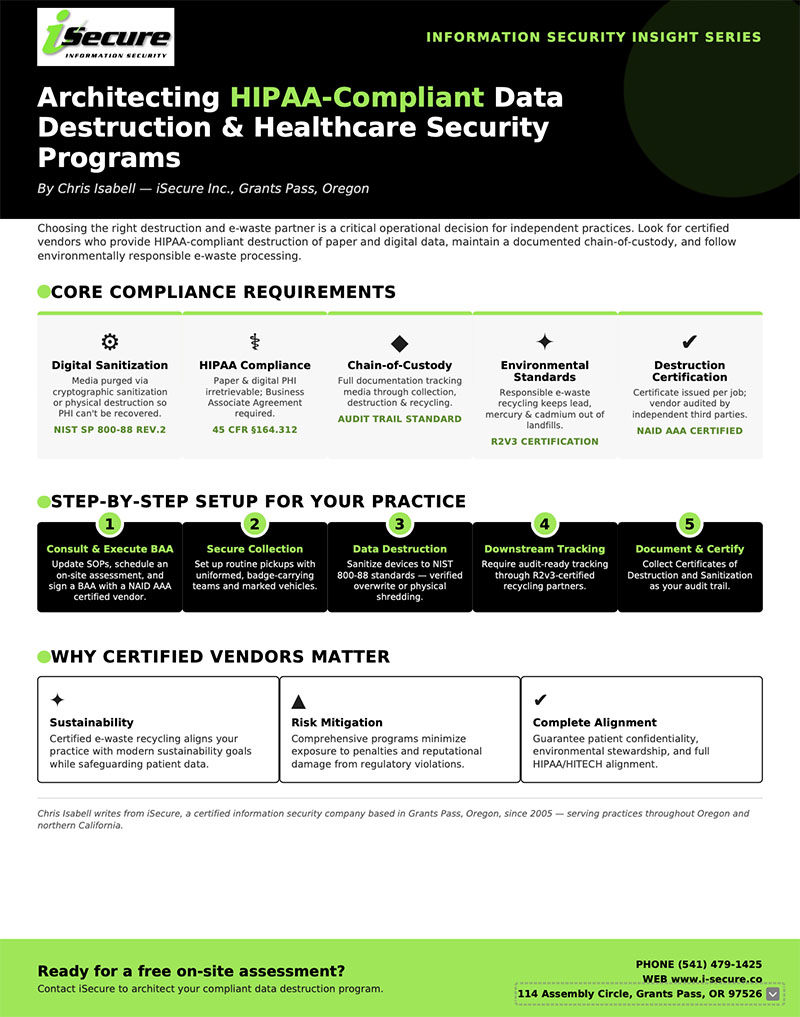
Core Requirements for Compliance
To build an impenetrable and compliant security framework, your practice must account for several distinct regulatory pillars. The following table outlines the core requirements you should integrate into your data security Standard Operating Procedures (SOPs):
| Requirement Area | Description & Best Practices | Key Regulation / Standard |
| Digital Sanitization | Digital media must be completely purged using cryptographic sanitization or physical destruction to guarantee PHI cannot be recovered. | NIST SP 800-88 Rev. 2 |
| HIPAA Compliance | PHI on paper and digital devices must be irretrievable; a Business Associate Agreement (BAA) is required. | HIPAA Security Rule 45 CFR §164.312 |
| Chain-of-Custody | Full documentation is needed to track paper media and devices through collection, destruction, and recycling. | Chain-of-Custody Audit Trail |
| Environmental Standards | E-waste must be recycled responsibly to stop hazardous materials like lead, mercury, and cadmium from entering landfills. | R2v3 Certification (downstream processors) |
| Destruction Certification | A certificate of destruction must be issued for every job, detailing the date, department, witness, and serial numbers. Using a NAID Certified vendor ensures regular vendor audits of personnel, procedures and equipment by third-party auditors. | NAID AAA Certification +
Certificates of Destruction |
Start Securing Your Data Today with iSecure!
Step-by-Step Setup Process for Your Practice
Implementing an effective end-of-life process for sensitive data doesn't have to be overwhelming. You can protect your practice by following this structured, step-by-step approach:
1. Consultation & BAA Execution
Start by updating your data security SOPs to explicitly outline the end-of-life process for both paper and digital media. Schedule an on-site assessment that includes an evaluation of your current equipment. Conduct internal compliance reviews and execute a Business Associate Agreement (BAA) with certified vendors to guarantee your practice is protected from HIPAA liabilities. When considering vendors, remember that NAID AAA Certification is the industry standard.
2. Secure Collection
Establish a routine for regular pickups or utilize on-site removal services. Professional vendors will typically provide secure handling via uniformed, badge-carrying teams and marked vehicles.
3. Data Destruction
Ensure any devices containing PHI undergo sanitization that complies with NIST 800-88 standards. This means utilizing either a verified purge-level overwrite or physical shredding of the hard drives, a standard you should formally add to your SOPs.
4. Downstream Tracking
It is vital to require audit-ready tracking in your SOPs. Working with certified vendors (such as those with R2v3 certification) ensures that materials are tracked downstream, confirming responsible recycling practices and keeping toxic materials out of landfills.
5. Documentation & Certification
Add requirements for Certificates of Destruction and Certificates of Sanitization to your practice's SOPs. These documents serve as the ultimate audit trail, demonstrating your preparation and the successful execution of an effective, compliant information security program.
Why Partnering with Certified Vendors is Essential
Managing secure destruction, digital sanitization, and large-scale e-waste is complex, but certified partners simplify your compliance with strict data security and environmental standards.
- Sustainability: A certified e-waste recycling program perfectly aligns a healthcare organization with modern sustainability goals while fiercely safeguarding patient data.
- Risk Mitigation: Comprehensive, certified programs minimize your practice's risk of facing severe penalties or catastrophic reputational damage resulting from regulatory violations.
- Complete Alignment: By adopting this structured approach, your healthcare organization can guarantee patient confidentiality, environmental stewardship, and full regulatory alignment with both HIPAA and HITECH laws.
To discuss architecting a compliant data destruction program for your practice, contact iSecure for a free on-site assessment

About the Author & iSecure Inc. Chris Isabell writes from iSecure, a certified information security company proudly based in Grants Pass, Oregon, since 2005. iSecure specializes in providing document destruction, hard drive destruction, IT asset disposal, recycling, and records management services to practices throughout Oregon and northern California.