
You can shred documents in Oregon at retail drop-off counters, like Staples or at UPS Stores; or at community shred events sponsored by banks etc.; also at some recycling facilities and plant-based shredding companies; or by scheduling a mobile on-site shredding service that destroys your paper at your address while you watch. Which option fits depends on your volume and on whether you need documented proof of destruction.
Businesses that handle client records or employee files usually need that proof, which is why on-site shredding is a common choice for offices and clinics across Oregon—from Albany to Eugene, Newport to Brookings, Redmond Bend and Klamath Falls and throughout the southern part of the great Beaver State.
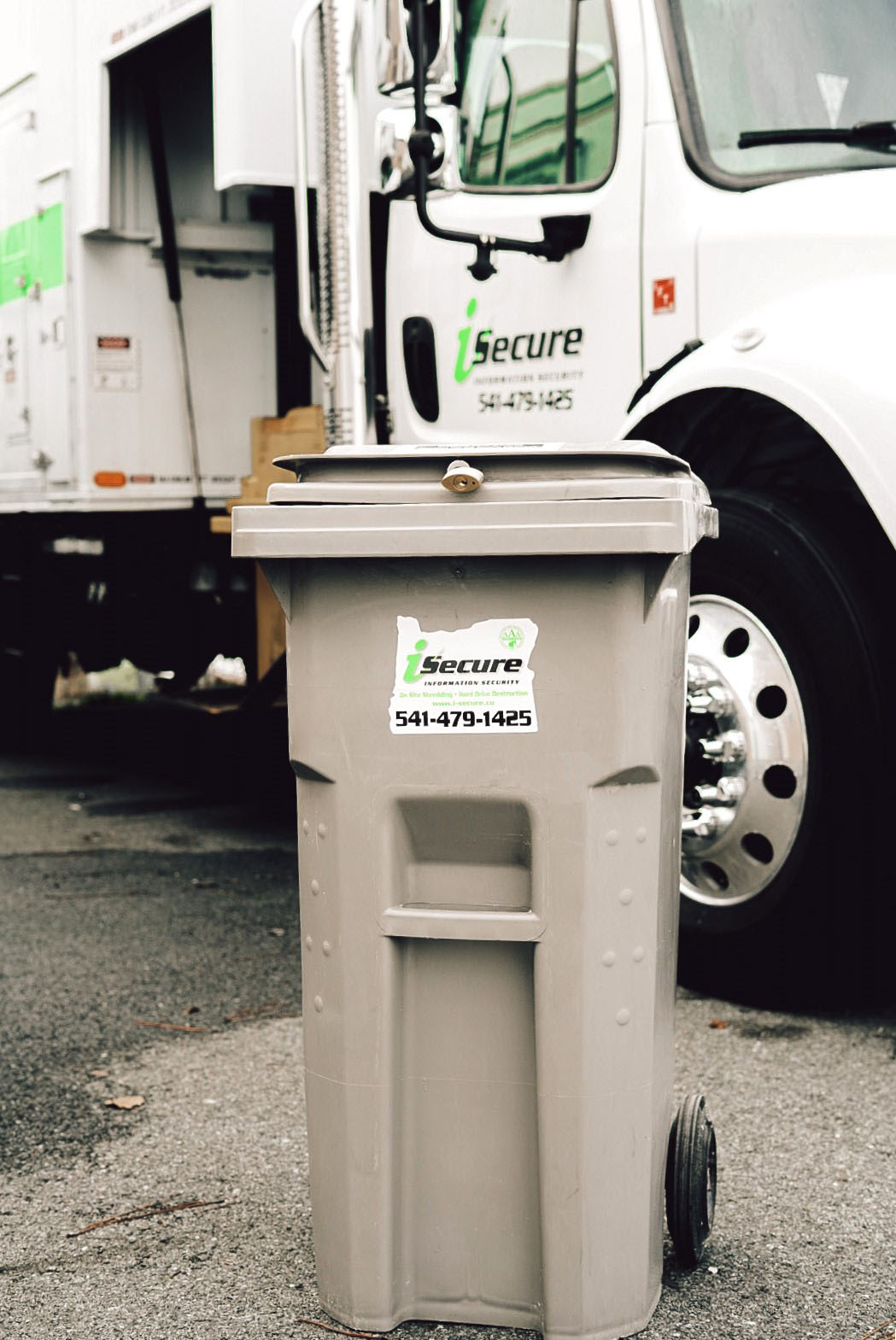
iSecure Inc. is based in Grants Pass and provides on-site document shredding throughout this region and most of Oregon and northern California, for both one-time purges and recurring service.
Your Options for Shredding Documents in Oregon
Retail Drop-Off Shredding
Average cost = $1.00 per pound. One full file box would be $25.00 at this rate.
Office supply and shipping stores often accept documents for shredding and charge by the pound. This works well for a small stack of personal papers, like a few years of bank statements. You hand your documents to a clerk, and the paper is typically bagged and sent to an off-site facility for later destruction.
The trade-off is visibility. You generally don't watch the shredding happen, and per-pound pricing adds up quickly once you're past a box or two.
Community Shred Events
Average cost = $0 per pound. One full file box would be $0 at this rate.
Banks, credit unions, city offices, and nonprofits host free or donation-based shred days, often in spring and fall. A shredding truck parks in a lot, residents line up, and paper is destroyed on the spot. These events are genuinely useful for households clearing out a closet.
Limits apply. Most events cap participants at a few boxes and run for only a few hours, and they're scheduled months apart. If your deadline is this week, or you have twenty boxes, an event probably won't work.
Recycling Facilities
Average cost = $.50 per pound. One (1) full file box would be $17.50 at this rate.
Some transfer stations and recycling centers accept paper, but standard paper recycling is not the same as secure destruction. Documents may sit in a bin or bale intact before processing. For grocery lists and junk mail, that's fine. For anything carrying a name, an account number, or a medical detail, choose a service built for confidential destruction.
Off-Site Shredding Services
Average cost = $.30 per pound. One full file box would be $7.50 at this rate.
With off-site shredding (sometimes called plant-based shredding), a truck collects your sealed containers and transports them to a facility where the contents are destroyed in bulk. It's an established, widely used model. Your paper leaves your building intact, though, so you're relying on the provider's chain-of-custody procedures rather than your own eyes.
Mobile On-Site Shredding Services
Average cost = $.40 per pound. One full file box would be $10.00 at this rate.
A mobile shredding truck comes to your address, and your documents are destroyed in the truck before it leaves. You can watch the process. For organizations that must document what happened to specific records, on-site destruction removes the gap between handing paper over and knowing it was destroyed.
Warning! Watch out for variable fees like surcharges that fluctuate and administrative fees that are difficult to identify or understand. These can increase your cost a lot and make it hard to manage.
This is the service iSecure provides, for one-time cleanouts as well as scheduled recurring pickups.
Get Started Today with iSecure Shredding Services!
Drop-Off vs. On-Site Shredding: A Side-by-Side Comparison
| Factor | Drop-Off Shredding | Mobile On-Site Shredding |
| Where destruction happens | Off-site, usually later | At your address, before the truck departs |
| Can you witness it? | Typically no | Yes |
| Best volume | A few pounds up to a couple of boxes | Boxes, filing cabinets, full purges, ongoing volume |
| Who transports the paper | You | The service technician |
| Typical pricing model | Per pound | Per service visit, container, or volume |
| Proof of destruction | Varies by provider | Certificate of Destruction issued after service |
| Ongoing programs | Not usually offered | Locking containers with scheduled service |
| Effort required from you | Load it, drive it, park, wait in line | Fill containers; the technician handles the rest |
| Good fit for | Individuals with small personal batches | Businesses, clinics, firms, agencies, large purges |
What Affects the Cost of Document Shredding?
Pricing varies by provider and by situation. These are the factors that move the number:
- Volume. How many boxes, bins, carts, or containers you're destroying. Recurring service is usually priced differently than a one-time purge.
- Service type. A one-time purge versus an ongoing schedule with containers kept on site.
- Frequency. Weekly, monthly, quarterly, or annual service is priced per visit, and regular service typically costs less per pound than an occasional single job.
- Location and travel. Distance from the provider's service base affects routing.
- Access at your site. Stairs, long carries, elevators, gated lots, or tight loading areas add labor.
- Container quantity and type. How many locking consoles or bins need servicing.
- Material condition. Binders, hanging folders, heavy clips, and similar hardware may need handling before shredding.
The reliable way to get a real number is a quote based on your actual volume and location. Request a quote with a rough box count and your address, and you'll get something specific rather than a range.
When Businesses Should Choose Professional On-Site Shredding
Consider scheduled on-site service if your organization:
- Handles patient, client, student, or employee records.
- Is required to maintain compliance records like an audit trail proving secure destruction policies are utilized and documented. The specific deliverables should be verified and discussed when selecting or reviewing a company.
- Retains financial documents, contracts, account information, or tax filings
- Is clearing out a records room or completing a retention purge
- Has staff spending working hours feeding an office shredder
- Wants a consistent, documented routine instead of ad hoc cleanouts
Medical practices, dental offices, law firms, accounting and financial services businesses, property management companies, public agencies, and schools tend to fall into more than one of these categories at once.
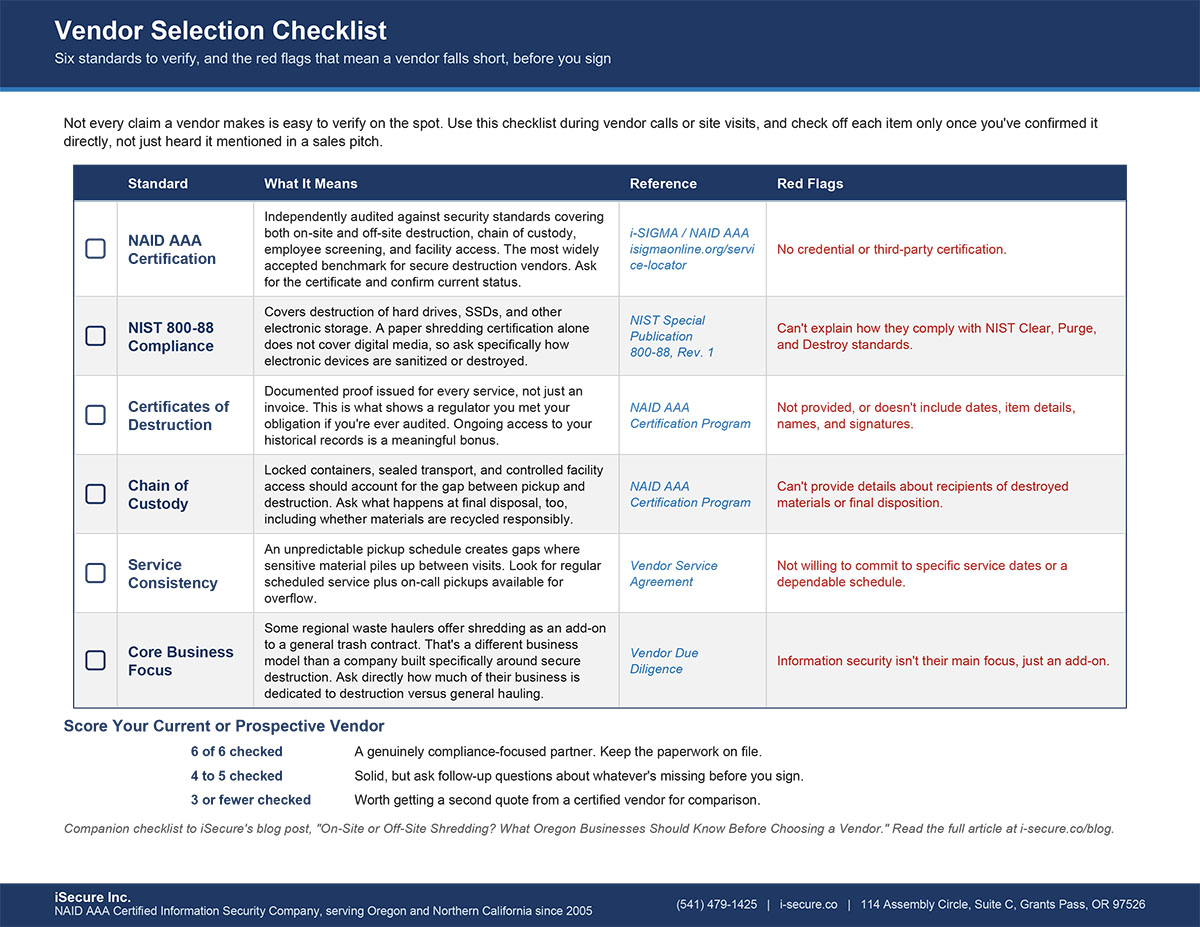
iSecure has created a 6-point vendor selection checklist to us when choosing secure destruction vendors.
How iSecure's On-Site Shredding Service Works
- Request a quote. Tell us your location, your approximate volume, and whether you want one-time or recurring service.
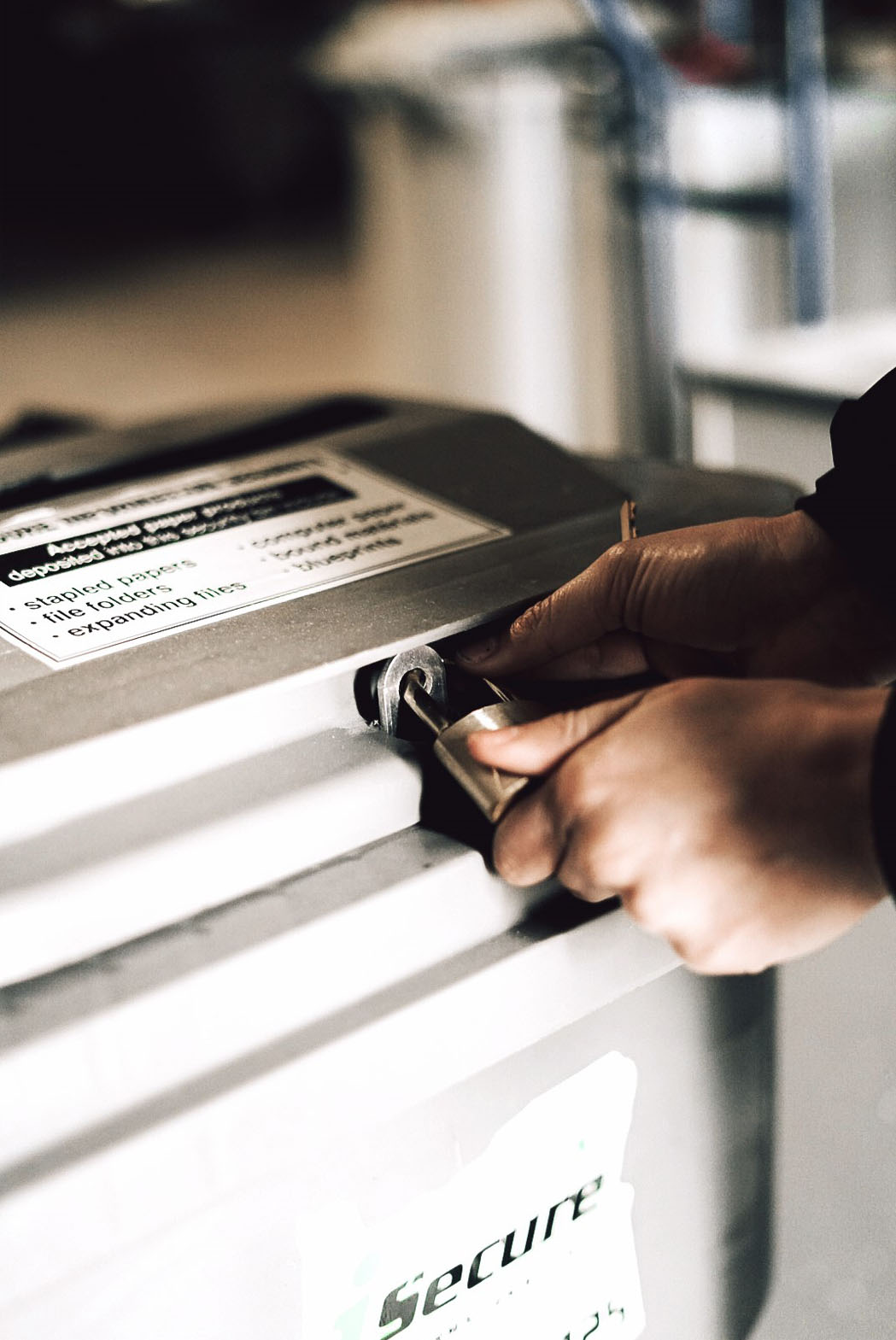
- Place locking containers (scheduled customers). Secure consoles or bins go where your staff actually works, so sensitive paper goes straight into a locked container instead of a recycling bin.
- A technician arrives on schedule. Our technician services the containers at your location.
- Documents are destroyed on-site. Material is shredded in our mobile shredding truck at your address.
- You receive a Certificate of Destruction. It's delivered digitally after service, for your records.
Service is available across Southern and Central Oregon and beyond, including Grants Pass, Medford, Roseburg, Klamath Falls, Bend, Redmond, Eugene, Springfield, Cottage Grove, Albany, Corvallis, and communities along the Southern and Central Oregon Coast. Check the service area page to confirm coverage for your address.
Which Documents Should You Shred?
Businesses and organizations:
- Client, patient, student, and applicant files
- Employee records, applications, payroll, and benefits paperwork
- Invoices, purchase orders, receipts, and accounts payable records
- Contracts, agreements, legal correspondence, and closed case files
- Financial statements, bank records, audit files, and tax documents past retention
- Internal memos, strategy documents, pricing sheets, and vendor lists
- Printed spreadsheets, reports, meeting notes, and draft presentations
- Expired ID badges, visitor logs, sign-in sheets, and access records
Individuals and households:
- Bank and credit card statements
- Tax returns and supporting documents past your retention period
- Pay stubs and benefits statements
- Medical bills, insurance forms, prescription labels, and explanation-of-benefits letters
- Canceled checks and deposit slips
- Pre-approved credit offers and loan paperwork
- Anything showing a Social Security number, an account number, a signature, or a date of birth
- Expired licenses, passports, insurance cards, and membership cards
Chain of Custody, Locked Containers, and Certificates of Destruction
Chain of custody is the record of who had your documents at each step, from the moment they go into a container to the moment they're destroyed. Fewer hand-offs means there are fewer opportunities for something to go missing. On-site shredding keeps that chain short, since the paper moves from your container into the truck's shredder without leaving your address.
Locking containers solve a quieter problem: the hours or weeks between the moment a page becomes trash and the moment it's physically destroyed. A locked console lets staff drop paper in without being able to pull it back out.
A Certificate of Destruction is your documentation that a service took place. It records the exact destruction event, so you have a written record instead of a memory. iSecure delivers yours digitally after each service. At a minimum, Certificates of Destruction should include . . .
- Date and time
- List of materials and quantities
- Name and signature of your employee and the shredding company
Frequently Asked Questions
Ready to Get Your Documents Destroyed?
Whether it's a single records-room purge or an ongoing program with locking containers at every desk, iSecure can handle it at your location, with a Certificate of Destruction to close the loop.
Request a free quote with your location and approximate volume, and we'll give you a straight answer on scheduling and cost.

About the Author & iSecure Inc. Chris Isabell writes from iSecure, a certified information security company proudly based in Grants Pass, Oregon, since 2005. iSecure specializes in providing document destruction, hard drive destruction, IT asset disposal, recycling, and records management services to practices throughout Oregon and northern California.