
Oregon healthcare organizations are reviewing expenses closely as Medicaid-related changes under H.R. 1, the One Big Beautiful Bill Act signed in July 2025, create financial and administrative uncertainty. State analyses project reduced federal Medicaid funding across coming biennia, though effects will vary by organization and payer mix. In that environment, healthcare data security can look like overhead: it generates no revenue and rarely appears in a growth forecast. But weakening essential controls trades visible savings for exposure that is harder to see, slower to surface, and far more expensive.
Why Data Security Becomes Vulnerable When Budgets Tighten
Security spending is easy to defer because nothing appears to break when you do. Under pressure, organizations commonly:
- Delay software and hardware replacements
- Reduce employee security training
- Select vendors primarily on price
- Postpone scheduled records and media destruction
- Allow retired computers and hard drives to accumulate in storage
Each decision feels temporary. The exposure is not. A box of closed patient files or a pallet of decommissioned drives holds the same protected health information it held the day it left service. Retired records and equipment stop producing value immediately. They keep producing liability until the data on them is destroyed.
Get Started Today with iSecure Data Security Services!
The Cost of Cutting the Wrong Controls
Healthcare remains a primary target. CISA identifies the Healthcare and Public Health Sector as one of the most frequently attacked critical infrastructure sectors, and HHS Office for Civil Rights breach reporting shows more than 700 breaches affecting 500 or more individuals in 2025, with hacking and IT incidents the leading cause.
The consequences reach past IT. Incidents have forced facilities onto downtime procedures, delayed scheduling, and disrupted care. Organizations then absorb forensic investigation, individual and media notification, regulatory inquiry, and contractual obligations to health plans and partners. OCR has also settled cases involving improper disposal of PHI, not only network intrusions. In communities the size of Bend or Redmond, patient and community trust is slow to rebuild once damaged.

Reduce Costs Without Reducing Protection
Four adjustments lower spending without lowering protection.
Consolidate destruction schedules. Reactive, one-off purges cost more than a routine service cycle. A predictable schedule across departments and satellite sites replaces expensive emergency pickups.
Review retention policies. Many organizations store records well beyond legal or operational need, paying for square footage and risk at the same time. Records must not be destroyed before applicable retention requirements and legal holds are satisfied — but once they are, continued storage is cost without purpose.
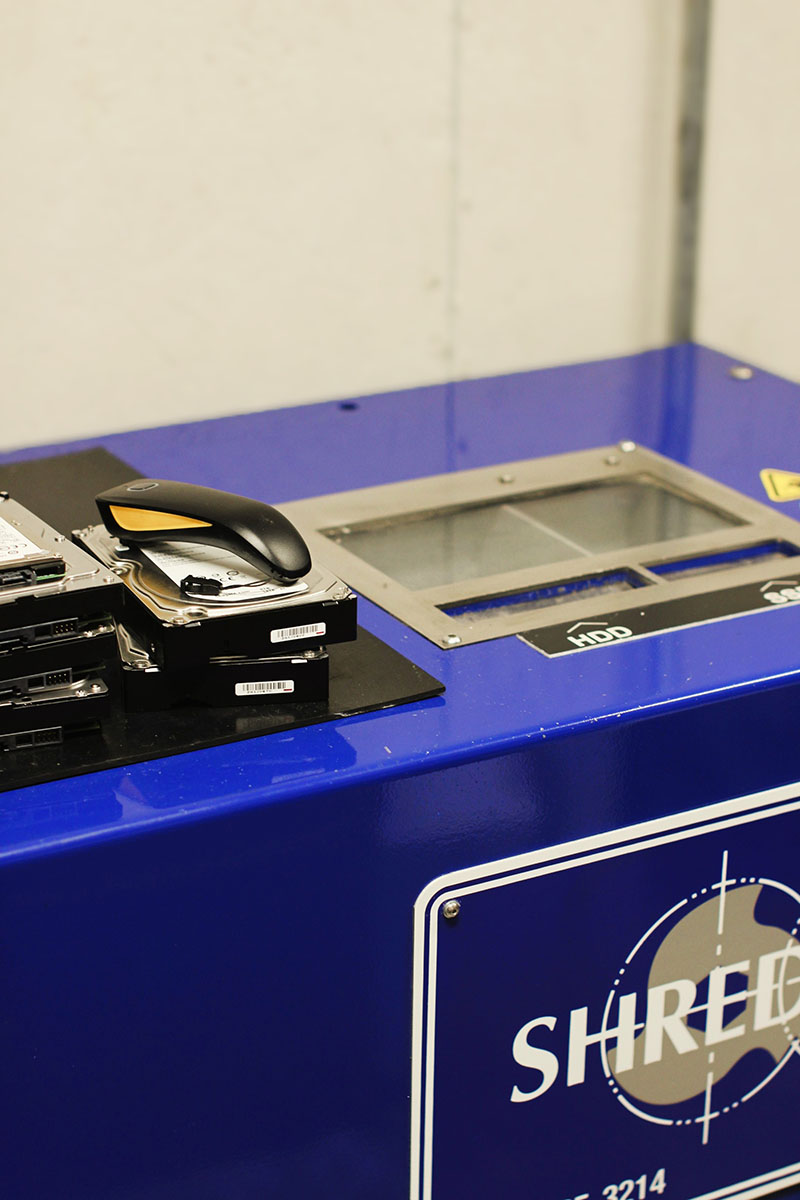
Coordinate technology refreshes with destruction. When drives, servers, and mobile devices leave service, schedule hard-drive destruction and IT asset disposition at the same time rather than months later.
Combine services under one vetted provider when appropriate. Document destruction, media destruction, and electronics recycling handled together can cut administrative time and per-visit cost.
Compare providers on total cost — administrative hours, chain of custody, reporting, certification, and downstream recycling — not pickup price alone. The difference between a vendor and a compliance partner usually shows up in those line items.
What Central Oregon Healthcare Organizations Should Require
Whatever the budget, require the same fundamentals from any provider serving Bend, Redmond, or the rest of Central Oregon:
- Documented chain of custody
- Secure handling procedures
- Background-checked personnel
- NAID AAA Certification
- A Business Associate Agreement where required
- Serial-number reporting for destroyed drives
- Certificates of Destruction
- Responsible downstream electronics recycling
- Accessible historical service records
HIPAA does not name a specific disposal method, certification, or document. It requires appropriate safeguards and disposal that prevents unauthorized access or disclosure. Certification and destruction records are how you demonstrate those safeguards were applied.
Get a Clear Picture Before You Cut Anything
Before cancelling a service, switching providers, or pushing destruction to next quarter, look at what you actually hold: how much is stored, how long it has been kept, what is scheduled, and what documentation exists. Most organizations find their savings in the schedule, not the safeguard.
iSecure’s Vendor Audit Checklist provides practical questions for evaluating any document-destruction, hard-drive-destruction, or ITAD provider. Request the checklist or contact iSecure to discuss your organization’s retention, destruction, and data-security needs.
Need Help With Your Organization's Data Security?

About the Author & iSecure Inc. Chris Isabell writes from iSecure, a certified information security company proudly based in Grants Pass, Oregon, since 2005. iSecure specializes in providing document destruction, hard drive destruction, IT asset disposal, recycling, and records management services to practices throughout Oregon and northern California.